Less Is More

“It is imperative that an international corporation adopt progressive environmental management practices aimed at pollution prevention in every facility it owns or operates throughout the world. The benefits include reduced environmental risks and costs, higher manufacturing efficiency and lower manufacturing costs, a positive public image and progress toward sustainable development.”

Rao, J.J.


The excerpt above was taken from a journal article entitled Preventing pollution around the world by J.J. Rao back in 2001. It discusses general strategies CPIs can adapt in order to minimize their wastes which brings about progress not only for the company but for the generations to come. The recommendations were simple yet effective and would certainly bring about a good kind of change. One key point of the article would be that pollution prevention is not an effort of only one sector or department in the company, but entails the cooperation, discipline and compliance of all. In a bigger scale, pollution prevention is never an effort of just one country.

1

Image taken from: http://solutions.3mbelgie.be/3MContentRetrievalAPI/BlobServlet?lmd=1271336995000&locale=nl_BE&assetType=MMM_Image&assetId=1258565727861&blobAttribute=ImageFile

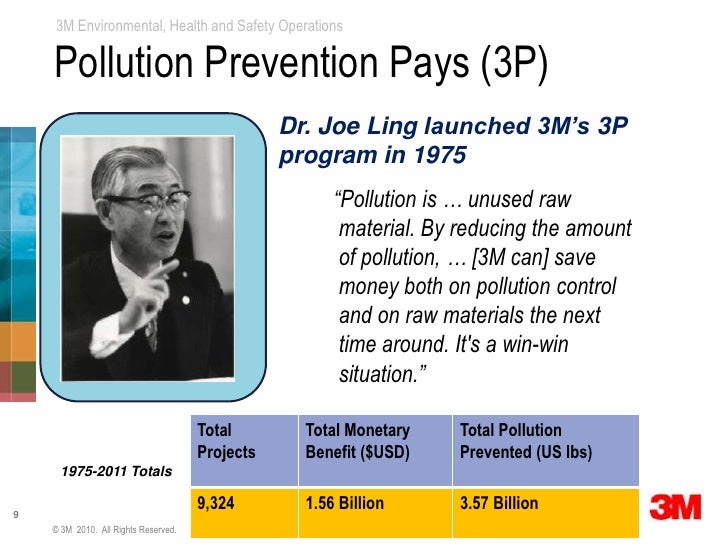
In 1975, 3M pioneered what could be considered as one of the most successful and influential pollution prevention program—the 3P or Pollution Prevention Pays. The title itself could be considered as a market strategy already. What company doesn’t want to reduce waste and gain profit at the same time? It’s like a kid on a Christmas morning.

As said by Rao (2001), reduced waste correlates to high manufacturing efficiency—which makes a lot of sense. High manufacturing efficiency entails excellent and efficient processes which optimizes the use of essential raw materials therefore minimizing the waste at the end. So, 3P does pay in terms of saving money intended for treating billions of pounds of industrial waste.

As Dr. Joe Ling elegantly puts it:

2

Image taken from: http://image.slidesharecdn.com/nelson-airqualitystandards-compliancereductionstrategies-120419125040-phpapp01/95/nelson-air-quality-standardscompliance-reduction-strategies-9-728.jpg?cb=1334860357

A person back in 1975 would have thought his words were bogus but facts never lie. In 2005, 3M reported to have prevented 2.9 billion pounds of pollutants and saved more than 1.2 billion US dollars worldwide; and as shown in the photo above, in a matter of 36 years, their 9,324 projects have prevented 3.57 billion pounds of pollutants and saved over 1.56 billion US dollars.

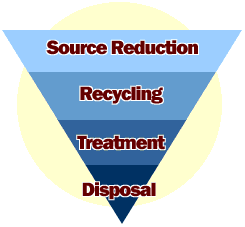
The concept was easy to understand one would think how else could people have missed it and ignored it for such a long time:
3

Image from: https://www.iisd.org/business/images/diagram_bt_pp.gif

The inverted triangle shows that it all starts in reducing the waste at its source. If pollutants can be eliminated through tweaking certain operations, the better. It also implies that at the final step, disposal, waste should have been greatly reduced if not completely eliminated.

As mentioned earlier, pollution prevention isn’t just an effort of one department, say the manufacturing department. Another good concept involved in the 3Ps is that it involves the voluntary participation of all employees. In 2002, the program was also expanded to include participation of R&D, logistics, transportation and packaging employees. Now, the 3P program (or pollution prevention programs in general) has been implemented by various companies around the world.

Now, it doesn’t take such a genius to implement the basic principles of 3P or pollution prevention in general. More than knowledge (which could be easily attained), discipline and compliance (which are harder to master, apparently) would play bigger roles in its success. 3P wasn’t made for just big-time industries, even households can certainly do it. So what’s an excuse for not doing it? Basically, none.


References:

Rao, JJ., (2001). Pollution prevention around the world. Chemical Engineering Progress: Nov 2001; 97, 11 (p. 38-31).

Sustainability In-depth: The Pollution Prevention Pays (3P) Program. Taken 10 February 2015 from http://solutions9.3m.com/3MContentRetrievalAPI/BlobServlet?locale=en_US&lmd=1240969645000&assetId=1180581674144&assetType=MMM_Image&blobAttribute=ImageFile.

Common Sense and Safety

For most of us, safety has been most probably discussed during an experiment in the laboratory in high school. I don’t remember how was it discussed or what exact points were discussed. For us chemical engineering students, safety is inevitably a part of our lives. But how do we really value safety? How important is safety for us compared to our core chemical engineering subjects?

Admittedly, in my early chemistry laboratory courses (sometimes, up until now), discussions pertaining to laboratory safety always come out as exaggerated. I mean, isn’t safety just common sense? Leaving laboratories behind, let us look at the typhoons that visit us every year; whenever a typhoon approaches the Philippines, the government and media give us these endless reminders concerning our safety. Again, I ponder, isn’t safety just common sense?

As shown in the video below, this man named Peter, with Youtube channel named RiskyBusiness, discusses why safety is not common sense.

Later on, I did realize that safety is not all common sense. As we have discussed in my Socio 10 class, it is common sense if it is common knowledge to a number of people. For example, in my Chemistry 16 laboratory, while some of us may already have a background on working in a laboratory, some of us may be in a laboratory for the first time. This calls for the need to discuss safety all over again. In our department, we have this laboratory safety orientation. When we, chemical engineering students, graduate and work in a plant, they have these safety standards, from proper protective equipment down to their plant protocols, which every employee should know.

But then, simple information dissemination or safety orientation is only one part of ensuring safety, may it be in the laboratory or in work or in our daily lives. It is also upon us to do our part. This is where situational awareness comes in. If we see something unsafe, it triggers our brain and we seek all knowledge pertaining to the situation and act accordingly. Situational awareness cannot be polished by any training; it comes with the experiences. This is why we have these drills and demos for us to know what to do, as much as possible, during these disasters.

Going back to the typhoons, more specifically, Ondoy, the common sense to the Filipino people living in Metro Manila, especially Marikina, is that typhoons do not necessarily result or have not been ever resulted to flood, thus the lack of need to evacuate. Don’t get me wrong and say that I am blaming these people. I am simply pointing out that if they had been properly informed about typhoons and their effects, the results may have been reversed. Situational awareness also plays a part in this, as they’ve recognized the danger of the increasing level of flood, they think about what they should do and how they should react to it. Unfortunately and ironically, they haven’t been in the same situation before, which would correspond to the experience Pete was talking about in the video and most especially, they haven’t been informed about how to deal with these kinds of situation.

We acknowledge the efforts of the department, the college and the government in increasing information dissemination regarding safety and disaster risk management. These safety and disaster risk management, however, should not be limited to those who work or to those at school. It should be made known to every concerned individual – educated or not, working or not. But they can only do so much. We, as individuals, should also do our part.

In the end, safety is a pinch of common sense and a spoonful of situational awareness.

References:

[1] “Why Safety is Not Common Sense? (1)” Retrieved February 3, 2015 from https://www.youtube.com/watch?v=0bZIbTx8dR0

Sustainable development in a continuously growing world (with a brief, first-post introduction)

This blog post marks the start of a wonderful online journey of three chemical engineering students through a semester of interesting and relevant topics concerned with the design for environment.

10402778_4892971857781_926152358436156712_n10881905_10203168742647581_4542111316700427923_n (1)1382196_10151910079419293_1839306098_n

The first two class meetings have been very chill and yet these classes were the ones we enjoyed the most. The class is somewhat unpredictable in such a way that the things we do are seemingly not the kind of things we normally do in the other stressful ChE subjects that we love. For example, we actually watched a John Green video (Crash Course, hooray!), which in other classes would be something like An Inconvenient Truth or The Great Global Warming Swindle (not like there’s anything wrong with those films, but John Green was a surprise). When our professor said that we were going to watch a video about the history of trains, we expected a historical documentary that discussed very technical details about it, being narrated by a monotonous, old man. The Crash Course video was able to show the technicalities, with a lot of extra bits of information relevant to sustainability and change, while being awesome at the same time.

Anyway, enough about that and on to the actual topic.

There’s been a lot of talk recently about sustainable development. People of the world have started to realize how man’s actions have led to harmful effects in the environment. There have been different protocols and movements that sought to mitigate the damage, starting with the Stockholm Declaration in 1972, which recognized that the matter of the environment should be a global concern. This includes common principles to guide and inspire the people of the world in the preservation and enhancement of the human environment. Major concerns were resource management, human settlement, identification and control of international pollutants, development and the environment. This heightened environmental awareness in the world, and resulted in a greater desire and need to preserve our resources.

Our_Common_Future_book_cover

In 1987, Our Common Future was published, bringing about the idea of sustainable development – “development that meets the needs of the present without compromising the ability of future generations to meet their own needs”.

Several other protocols and movements followed, such as the Kyoto Protocol, the Montreal Protocol, and the Rio Earth Summit, among others. Currently, different governments and industries claim to be doing processes toward sustainable development. But with the continuous increase in the world’s population, will all these movements and processes really suffice?

According to The Economist, almost half of the world’s children may be African by the end of the century. This idea was mentioned in our ChE 198 class discussion regarding the anthropocene. In an STS class I had the day before, we discussed the similar topic of increasing population – the greatest percent increase belonging to the African population. It was explained that this was due to the fact that African women have the highest fertility rate, meaning they raised the greatest number of children on average compared to other countries of the world. This is shown in the african bulge, a forecast of the world’s population until the end of the century.

20140823_MAC567

If this trend does continue, and the current state of Africa remains the same, the world is in big trouble. If right now, Africa is having a hard time feeding a billion people, what more if it reaches four times that size? And if we humans continue to abuse and exploit the environment, how will it be possible to sustain the Earth for future generations?

References:

[1] What is sustainable development. Retrieved January 27, 2015 from http://www.worldbank.org/depweb/english/sd.html

[2] Africa’s population: Can it survive such speedy growth?. Retrieved January 27, 2015 from http://www.economist.com/news/middle-east-and-africa/21613349-end-century-almost-half-worlds-children-may-be-african-can-it

[3] Report of the World Commission on Environment and Development: Our Common Future. Retrieved January 27, 2015 from  http://www.un-documents.net/our-common-future.pdf

[4] Declaration of the United Nations Conference on the Human Environment. Retrieved January 27, 2015 from http://www.unep.org/Documents.Multilingual/Default.asp?documentid=97&articleid=1503

Hello world!

Hey you! Yes you!

Thank you for visiting our blog dedicated to our ChE 198 subject, Design for the Environment. We hope you enjoy reading the different entries and feel free to comment and reblog!