The arbitrary value of money.

(Hi, sorry for the slightly long post. It’s my last, so I hope you’ll understand 😉 )

Hi fellow money spenders. The semester is coming to a close. We’ve undergone tons of requirements, exams, sleepless nights, eyebags, heartache, late morning gisings, hunger, heat, a lot of heat, ups and downs (literally up and down the stairs), cramming of requirements, walking, scrolling down fb, being tired, loving our beds and never wanting to leave them, running, the new ChE building and its oh so white-ness, 135 and 124 and 140 (for them 4th years), PD AND THESIS (HUHU, for them 5th years), 198 blogposts :>, delivery at ChE building, late night permits, plenty of permits and paperwork to be submitted, life, and love and randomness.

(Kinda had a hard time thinking about what I’d possibly write about in this post. Kind of felt a bit pressured since this will be my last official blogpost for 198. But who knows, maybe we’ll continue to use this blog as a form of outlet for environment related feels and rants and insights. Or just feels. We’ll see. Sorry for the deviation from the topic. I’m getting there, I promise!)

Hi again. So, my point. In all those I mentioned, and even those I didn’t, money is present. Money is everywhere!!! Check your pockets, your bags, your table, the floor (if you’re lucky enough). Money is our phone, laptop, bag, watch, clothes. Money $$$$$ $_$ ka-ching, ka-ching.

We’d be nothing without money. We need money to live. Life kind of stops when we’re bankrupt. We seem to not be able to do things properly. We can’t buy food and drinks, can’t communicate (load/internet), can’t move from place to place (pamasahe/gasoline). We can’t study (tuition fees and books, although there are exceptions). We can’t pay for our lab fees, we can’t do our thesis (where most of the 5th year money goes to), we can’t buy books, we can’t eat out, we won’t have clothes. Imagine going to school with no money at all. You’d be restless.

Anyway, my point again. Well, money pretty much makes the world go round. However bad that sounds, it’s true. I mean, I guess it isn’t the only thing that makes the world go round. There are other things like love and angular momentum.

(See link to song: https://www.youtube.com/watch?v=n-I2qF-aMUo)

But if you really think about it, money was just made up. It can be anything. Like I mentioned, money can be a ring, a rock, a mushroom, a piece of lego, or even Perry’s Chemical Engineer’s Handbook. It’s arbitrary.

According to Investopedia.com (a website which explains money related things in layman’s terms), money derives its value by being a medium of exchange (we’re lucky not to have “coins” as heavy as Perry’s), a unit of measurement and a storehouse for wealth. It allows human beings to indirectly exchange goods and services, through the value or price given to them.

Money has been part of the world for at least 3000 years. Before its invention, a system of bartering existed. This involved a direct trade of goods and services – I’ll give you spaghetti if you give me kiwi. But this cannot happen instantly since the trade has to be fair for both parties, someone will have to want to give away what he has for what you have. And it will take time to find the right match for the trade. One of the great things about money is how it was able to increase the speed of trade by providing a common medium of payment.

The currency of trade then started to develop over the centuries including animal skin, salt, and weapons. This spread throughout the world and in some places, are still being used today. Weapons such as daggers and sharp arrows were used as money but this had a hazard for the people since it may injure them, thus the circular coin was developed to address this problem. Over time, paper money was also introduced. And after many centuries, our form of trade that started from a simple exchange of anything a person can offer, has evolved into the system of exchange it is today.

It is often said that money is the root of all evil. Money is a very complicated thing. Because of how much “power” we’ve given to it, sometimes it inevitably takes control of our lives.

I was able to somehow experience the sadness of how much money matters, during a certain event in my life. I had to evaluate the feasibility of a certain project in terms of chemical engineering principles. After passing the technical evaluation, an economic analysis was performed for the proposed projects. However, they did not pass. The calculated NPV and IRR were negative. It was sad because I spent so much time finding out if they were technically possible, and yes they are; only to find out that the projects would fail the economic analysis. This goes to show that although something is technically possible and would allow for better operation of the plant, money is still always taken into account.

The same goes for our plant design. What is considered to be a feasible plant to build is a plant that would be profitable. What’s the point of building a plant if it cannot generate profit?

It is also noted how detailed the costing calculations are for the equipment, utilities, maintenance, rent, insurance, administrative costs, research and development, and other plant costs that are too many to mention. The total capital investment is calculated from all these. Then an economic analysis is performed to determine the NPV, IRR, payback period. As of now, the calculations can be done, however tedious they may be.

But what if money was never invented in the first place? How would this economic analysis be done? Or would there even be such a thing? How would we even begin to do our cost analysis in the first place? It is now difficult to imagine a world without money. Despite the stress it brings to us today, it is still a more organized way of dealing with exchange of goods and I think that our economic analysis for plant design would be much more difficult especially if we have to pay for our equipment using cow skin or bows and arrows.

P.S. Yeyyy! Go us, goodluck on our remaining requirements!!!

References:

[1] Beattie, A. The History of Money: From Barter to Banknotes. Retrieved 16 May 2015 from http://www.investopedia.com/articles/07/roots_of_money.as

LCA: What the Big Guys are doing

Life Cycle Assessment provides the techniques to assess the overall environmental effect of products from sourcing raw materials to the disposal of the final products. It has become a good measure of the environmental impact connected to various inputs and releases.

A crash course on the definition and importance of LCA can be found in the following video:


In order to fully understand the implications of doing LCA, here are some important evaluations and assessment made by some companies whose products we all probably know:

1. Levi Strauss & Company

Levi's_logo

While the struggle to find the perfect jeans is real, the environmental impact of making and using one Levi’s jeans is also real. The LCA work done in 2007 revealed that a typical pair of blue jeans consumes 919 gallons of water during its life cycle—enough to fill 15 spa-sized bathtubs. Better think again when you want to wash those barely worn jeans! Currently, the focus of the company is improving their process to lessen water usage of their product.

2. NIKE, Inc.

nike

Apart from looking at the impact of our running to our overall fitness, our very own NIKE shoes have their own footprint that affects the environment. Comparing the Air Pegasus in 2008 with the ones released in 2014, the Air Pegasus now uses fewer materials as well as less water, energy and chemically intensive. So go ahead and buy a new pair. They’re not only lighter and beautiful to look at, they’re also more environmentally-friendly.

Read more here: http://www.nikeresponsibility.com/report/uploads/files/Product_LCA_Method.pdf

3. Apple, Inc.

Apple-logo1

While taking selfies in your iPhone, it’s also good to think that in the past years, Apple Inc. has been doing good in reducing their total greenhouse gas emissions. While bulk of the emissions come from the production accounting for 65% for iPhone 4, customer usage still plays a large role in the emissions amounting to 26%.

Read more here: http://www.seeds4green.net/sites/default/files/iCycle.pdf

4. Coca-Cola Company

2000px-Coca-Cola_logo.svg

Packaging has been one of the major challenges faced by the Coca-Cola Company since 1969. They are one of the first companies to engage in LCA to evaluate their products. Their life-cycle management focuses on sustaining the use of high value recyclable materials and reusable packages.

Read more here: http://www.ftms.edu.my/pdf/Download/UndergraduateStudent/internationalenvironmental/LCA_07.03.pdf

5. Proctor & Gamble

PGPhaseLogo

P&G has conducted a comparative LCA for their Ariel detergents in 1998, 2001 and 2006. The study shows apart from improving the packaging and chemistry of the detergent, they have also improvident the average wash temperature of the product as well as the effective dosage. So, not only can you buy Ariel at a lower price, you definitely can wash more with it. Finally!

Read more here: http://www.jmu.edu/EnvironmentalMgt/Courses/ISAT422/Supplements/Laundry%20Soap%20LCA.pdf

While LCA may entail more time and more critical analysis of the product life cycle, not does it reduce the environmental impact of the products, it also provides great room for improvement for the manufacturing company which, if properly applied, can boost sales significantly.


References:

[1] https://www.youtube.com/watch?v=ebOq74HotmQ

[2] http://www.life-cycle.org/?p=1420

[3] http://www.nikeresponsibility.com/report/uploads/files/Product_LCA_Method.pdf

[4] https://www.apple.com/au/environment/answers/

[5] http://www.seeds4green.net/sites/default/files/iCycle.pdf

[6] http://www.coca-colacompany.com/stories/reduce#TCCC

[7] http://www.ftms.edu.my/pdf/Download/UndergraduateStudent/internationalenvironmental/LCA_07.03.pdf

[8] http://www.jmu.edu/EnvironmentalMgt/Courses/ISAT422/Supplements/Laundry%20Soap%20LCA.pdf

Want some food?

I was supposed to write a blog post about the journal, “Life Cycle Assessment: Past, Present, and Future” by Guinee, Heijungs, Huppes et al. But then, we love the enggvironment has already posted something about this. Which was also why it took me this long to write a new blog post. Next to that journal, what has caught my attention was Life Cycle Assessment (LCA) on food.

food

When you think of food, what really comes to mind is the taste, the flavor, the amount of calories it has (if you’re health conscious), and sometimes the price, but never the effects of it on the environment. Instead, one of the more pressing issues that concerns food is world hunger and its relation to poverty. For me, solving this issue shouldn’t only focus on how to mass produce food to feed those who are starving. The people trying to solve this issue should look into the bigger picture; they should include how their proposed solutions would affect the environment. We live in a place where all actions have corresponding consequences and solving world hunger may cause detrimental effects on our environment, then again, these effects on the environment may cause problems with food production, and the cycle goes on and on.

In general, Life Cycle Assessment studies have been employed before and usually focuses on environmental efficiency on food production, that is decreased environmental impact per unit output (Hellar, et al, 2013). Of course, if there is a production-oriented approach on LCA, there is also consumption-oriented approach on LCA. The latter focuses on the effects on the environment of food consumption based on consumption patterns in meal or in diet and their key characteristics. Shown on the figure below are different functional unit basis for different research goal and scope for both production and consumption oriented life cycle assessments.

LCA

 However, life cycle assessment to date has accounted nutrition in food consumption in its studies. According to the study of Heller et al, there are two general categories under this new approach: (1) designing or modifying comparative meals or diets such that they provide equivalent levels of relevant nutrients, and (2) employing nutritional quality indices as indicators of supplied nutrition. The figure below shows a basic framework on how nutrition is integrated in a life cycle assessment.

nutrition

When solving the world hunger problem, the amount of supplied food shouldn’t be the only concern; the supplied food should also be good for the health of those who are going to consume it. As a daughter, I always remind my dad not to eat fatty food ’cause it is bad for his health. But he would always oppose me and tell me that we’re lucky that we even have food to eat and this saying that “Kung patay, patay! Yung iba nga diyan, namamatay dahil sa gutom. Buti tayo, may nakakain pa.”, which means that it is worse to be killed by hunger than by a heart attack due to cholesterol buildup. Well, I guess that’s the thing, the nutrition should not be sacrificed when it concerns food. It is never just about the amount, but also about the quality. That is why these new trends that account nutrition in food consumption life cycle assessments are good efforts and should be further improved to help the problem on world hunger and environmental sustainability in general.

References:

  1. Heller, M.C., Keoleian, G.A., Willett, W.C. (2013) Toward a Life Cycle-Based, Diet-level Framework for Food Environmental Impact and Nutritional Quality Assessment: A Critical Review. Environmental Science and Technology, 47, pp. 12632-12647.
  2. Shah, A. (2010) World Hunger and Poverty. Global Issues. Retrieved from http://www.globalissues.org/issue/6/world-hunger-and-poverty last 23 April 2015.

Earth Hour (post-break post)

Hello engineering world, after a long time. Well this post is a bit hard to construct, considering that more than a week has passed since the last lectures.

The saturday before Holy Week was March 28 and at 8:15 in the evening, the world celebrated Earth Hour 2015 where millions unite for climate action. Earth hour is a global movement by the World Wildlife Fund (WWF) that began in 2007 with partners in Sydney, Australia. After 8 years, it has now spread to ~7,000 towns and cities around the world. Around 2.2 million people worldwide turn off their lights as a sign of solidarity.

However, this movement, like many others, have been criticised and it has been asked if it really makes any difference, if it does any good. Some argue that although the lights are turned out, the generators are still running. They also say that the energy needed for people all over the world to drive the Earth Hour parties just cancel out the energy saved by turning out the lights. In addition to this, millions of batteries and candle wax were consumed in the process. Furthermore, they say that Earth Hour will not reduce carbon emissions. With some data from energy experts it is said that although power stations are shut down, the upsurge when the lights are turned back on will require power stations that can fire up quickly like coal and oil. Energy experts say that Earth Hour could even result to an increase in carbon emissions, making it useless.

But Earth Hour goes far beyond that one hour of lights out. And reducing carbon emissions is not really the main point, according to WWF. It is about raising awareness, to save energy in the long term. It aims to call for action on global climate change.

With 172 participating countries and territories, around 1,400 iconic landmarks switched off, 66 countries that have gone beyond turning off their lights, more than 378 million Twitter reach, 36.5 million video views, and 5.9 million Facebook reach, Earth Hour has been able to definitely make a difference. It may not solve all of the world’s problems, but definitely it has been able to truly raise awareness. It is the simple movements like these that will enable great change in the future. If only we all are able to participate and launch movements, as individuals, we can make a change and help save the earth!

Watch the official Earth Hour video here:

References:

[1]https://www.earthhour.org/

[2]http://ecosalon.com/does-earth-hour-really-make-a-difference/

[3]http://www.telegraph.co.uk/news/earth/environment/climatechange/7527469/Earth-Hour-will-not-cut-carbon-emissions.html

Environmental Fate: Breaking Bad Style

Environmental fate would give an idea of what happens to chemicals once it is discharged into the environment. There are many ways to express the environmental fate of a particular substance. Most of it are defined by properties of these chemicals which can be calculated using models and software available.

Environmental fate does not only concern itself with what happens to the chemicals. It also involves analysing potential hazards and problems that may arise when they come into contact with organisms such as plants, animals and of course, humans. It can also provide information as to whether certain chemicals may cause adverse effects to the environment especially in the soil and bodies of water.

The importance of evaluating the environmental fate of a chemical should definitely not be taken lightly. What’s sad is that while industries are required to follow regulations on chemical disposal and treatment, there are still those individuals who just don’t seem to care.

Take meth, for example. Meth, or methamphetamine, is a well known synthetic drug not just because of the Breaking Bad series but also because it is considered as one of the most dangerous drugs. While the chemistry behind it could be considered awesome in some sense, its effects—not only upon human intake but also on the environment—are very disheartening.

The following video shows a news report on the environmental impact of the drug:

*Video taken from YouTube: https://www.youtube.com/watch?v=n7P776LKvp0

As seen in the video, for at least six (6) pounds of toxic waste is generated for every 1 pound of the drug. Chemicals used to make meth include acetone, toluene, hydrochloric acid, sodium hydroxide, and anhydrous ammonia. Just the mention of these chemicals would make one cringe when thinking of it being carelessly exposed to the environment. The sad truth is, they are just dumped into the environment with its production and selling being illegal and all. I think only Walter White has the decency to even think of the proper place to make it and dispose of it—even if he is fictional and it is a series.

Nevertheless, there are other chemicals that are being discharged into the environment everyday. Sometimes, we too are guilty of just dumping waste down the drain without even reading the proper disposal on the container labels.

So, what’s the point exactly? The point is, environmental fate is more than just the numbers. I mean, it doesn’t make sense to even calculate numerous values when in the end, all we care about is getting the numbers right and not really what it means.

As engineers, I believe we are not just expected to create less environmentally-degrading products using tools like evaluating environmental fate but we should be pushed into eradicating them, if possible. It may seem highly idealistic and it is but it is what it is. Then again, it may not be. In the end it’s all just a matter of perspective.

And as one of my professors put it:

Save the earth! It’s the only planet that has chocolate!

Sources: methproject.org

“Pollution prevention through process integration”

Process integration is a holistic approach to process design and operation. It emphasizes the unity of the process units and objectives. Therefore, it provides unique framework for integrating environmental issues with other process objectives such as profitability, yield enhancement, debottlenecking and energy reduction.

-Mahmoud M. El-Halwagi

This blog post will basically tackle what El-Halwagi’s paper, the Pollution prevention through process integration.

Traditional pollution control consists of end-of-pipe treatment and disposal. End-of-pipe treatment refers to the reduction of the magnitude of environmentally undesirable compounds in process streams prior to their release to the environment through the application of chemical, biological and physical processes. On the other hand, disposal involves the use of postprocess activities that can handle waste.

The problem with this traditional pollution control is that it does not deal with the root causes of the environmental problems. These problems lie at the core of the process which resulted to new ways for pollution control, namely the source reduction and the recycle/reuse. Source reduction means to eliminate waste before it is created. It involves any in-plant actions to reduce the amount of the quantity or toxicity of what is thrown away. Recycle/reuse are pretty self-explanatory which involves the re-introduction of pollutant-filled streams back into the process.

However, these new ways of pollution control, or in-plant pollution prevention have posed some challenges summarized below.

  • There is no single menu of solutions that fits all. These pollution prevention technologies should be added in the periphery of the process.
  • A change in a unit or a stream propagates throughout the process and may have mahor implications on the operability and profitability of the process.
  • The technical, economic, safety and environmental objectives and constraints must all be reconciled.
  • The solutions lie within the existing process equipment. However, it isn’t obvious how to identify these opportunities.
  • Solution cannot be replicated from one process to another even if they have common technology.

With this, process integration addresses these challenges through three key components: synthesis, analysis and optimization.

Process synthesis deals with combining and integrating process units and streams so as to meet certain objectives.

Process analysis involves the decomposition of the whole into its constituent elements for individual study of performance.

Process optimization involves the selection of the “best” solution from among the set of candidate solutions. The degree of goodness of the solution is quantified using an objective function, e.g., cost, which is to be minimized or maximized.

Process integration has two main branches: the mass integration and energy integration. For our class, the discussion started with energy integration, more specifically, the heat exchanger network.

Energy integration is a systematic methodology that provides a fundamental understanding of energy utilization within the process and employs this understanding in identifying energy targets and optimizing heat-recovery and energy-utility systems.

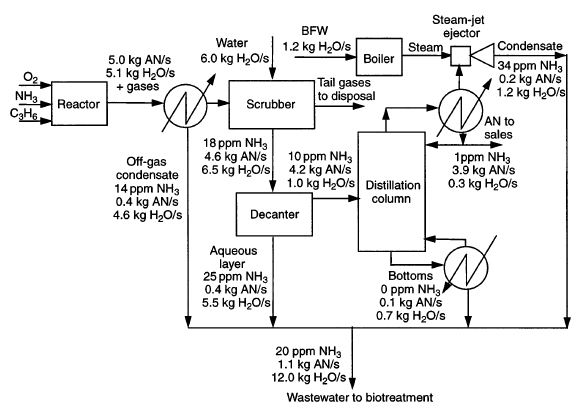
Acrylonitrile production

                                                          Acrylonitrile production

Just last week, we just finished the mass integration, or the mass exchange networks. We were given a seatwork on this topic. The process flow diagram of this seatwork is shown above, the acrylonitrile production, also discussed in this El-Halwagi’s paper. We were asked how to reduce the need for a fresh water source for the scrubber and the boiler.

The first step in conducting mass integration is the development of a global mass allocation representation of the whole process from a species viewpoint (El-Halwagi et al. 1996, Garrison et al. 1995, 1996). For each targeted species, there are sources, streams that carry the species and sinks.

El-Halwagi stated that in general, sources must be prepared for the sinks through a combination of stream segregation, mixing, recycle, interception and and sink/generator manipulation.

Segregation refers to avoiding the mixing of streams. Recycle refers to the use of a pollutant-rich stream, also known as the source, in a process unit, also known as the sink. This sink, however, has restrictions such as flow rate or concentration of contaminants. This is where interception comes in. It is the utilization of separation unit operations to adjust the composition of the source to make them acceptable for sinks. This entails the use of mass-separating agents (MSAs) or energy separating agents (ESAs). Lastly, the sink or generator manipulation involves the design or operating changes that alter the flow rate or composition of the source entering or leaving the process units. This includes temperature and pressure changes, unit replacement, catalyst alteration, feedstock substitution, reaction-path changes etcetera.

Personally, learning about and solving problems on mass integration is just as fun as in heat exchange networks. But the former seems more complicated than the latter. 🙂

References:

El-Halwagi, M. M. (1998) Pollution prevention through process integration. Clean Products and Processes 1. pp 5-19

HEN Application

Last week, we were tasked to do a homework re: heat exchange networks. The problem is stated for your reference:

To produce a high purity product, two distillation columns are operated in series. The overhead stream from the first column is the feed to the second column. The overhead from the second column is the purified product. Both columns are conventional distillation columns fitted with reboilers and total condensers. The bottom products are passed to other processing units, which do not form part of this problem. The feed to the first column passes through a preheater. The condenser from the second column is passed through a product cooler. The duty for each stream is summarized below:

Screen Shot 2015-03-10 at 2.02.17 AM

The minimum approach temperature used was 10degC.

The temperature was divided into 10 segments as shown in the table below. From here, the total heating and cooling loads were calculated and the pinch point was determined to be at 70degC with external heating load of 2300kW and external cooling load of 1600 kW. The solution is shown in the figures below. The respective CP’s were calculated using the equation Q=CP*(deltaT).

Screen Shot 2015-03-10 at 1.32.12 PM

Screen Shot 2015-03-10 at 2.18.53 AM               Screen Shot 2015-03-10 at 2.47.13 AM

Now we need to determine which streams are going to be paired with each other, knowing the pinch point temperature and the external heating and cooling loads.

Screen Shot 2015-03-10 at 1.24.34 PM

Above the pinch (T>70degC), we only have stream 4 and 5, which cannot be paired together since there is not overlap in temperatures and since both are cold streams. Thus, an external heating load is calculated using Q=CP*(deltaT) to get 2300 kW required external heating, which is what we were able to compute earlier. Below the pinch, there are 4 streams – 1, 2, 3, and 6 which correspond to C1, H1, H2, and H3, respectively. Below the pinch the number (and heat capacity) of cold streams must be less than or equal to the number (and heat capacity) of hot streams. Both of these conditions are satisfied so there is no need to split the streams. The cold stream, C1, can be paired with either stream 2 or 3 (H1 or H2). Pairing it with H2 will lower the H2 temperature to ~56.8degC and will need external cooling to lower the temperature further down to 55 degC. Adding the external cooling required for H1 and H3 will result in a total of 1600 kW external cooling load required. Which was what we calculated. A similar calculation can be done by pairing C1 with H1. The same external cooling would also be calculated. Now to select which of these we should use, we must take into consideration the costing and other trade-offs of equipment design. That is another matter which we may possibly discuss in future blog entries. 😉

BIG THINGS MAY COME IN SMALLER PACKAGES

Many attempts have been made by chemical process industries or industries in general geared towards minimization of waste and prevention of pollution without sacrificing much of the quality and profitability of their products.

One key factor that links all four categories listed beforehand would be the process undergone to produce the products itself. The production process starts from the sourcing of the product up to the delivery of products to distribution sectors.

In this blog entry, what will be focused on would be the integration and synthesis of different unit operations and processes which is a helpful tool in deciding the design of the whole industrial process.


Process Integration in simple terms would have to be putting together larger processes to form smaller and more efficient operations. It involves revising parts of the original process and looking for areas which can be utilized and reduce the number of mechanical parts and machines needed in the production.

For example, in heat exchange, both minimum external cooling and heating loads can be identified (using both Algebraic and Graphical methods) so as to maximize the heat exchange potential of all hot and cold streams and to minimize the number of utilities to be used in heating and cooling the product. This may not only lower costs in buying the heat exchangers and utilities, it may also improve the quality of the product depending on the heat exchange calculated.

Another advantage of Process Integration is that it helps lessen the amount of waste generated by the process. Along with identifying steps which could be done simultaneously or using one unit only comes the discovery of steps which generate the highest amount of waste whether it be harmful or not. Using process integration, these steps can be further developed and change so as to lower the amount of waste generated for the whole process. This does not only increase the efficiency of the operation but also lowers costs for the treatment of these wastes.

With advantages come the disadvantages of using Process Integration. More often than not, there would be more than one way to enhance the process in an industry. This is because there are many areas to choose from in which process integration may be applied and with every option comes the cost for either buying the equipment, maintaining the equipment and more. This is also the reason why all designs would often come with a financial proposal listing both costs and profits for either long term or short term perspectives.

Another risk in using process integration would be the assurance of still high quality products. The standards for the products would still have to be met which includes the pricing of the products which is also affected by the kind of processes undergone by the raw materials. And while waste minimization may be a result of process integration, it may also be a negative effect.

At the end of the day, it all comes down to compromise. While it is true that process integration is a helpful tool in creating a more organized and efficient plant design, its effects to the quality, cost and waste generation should also be taken into careful consideration. This may be the reason why some companies still rely on long and arduous processes which may not be as efficient as they want it to be but nevertheless delivers the quality, cost and waste generation they desire.

A Hazardous World

Last February 2, the senior (4th and 5th year) chemical engineering students attended the Lab Use Orientation and Safety Seminar or basically a reminder for us all to be aware of our surroundings and to know the basic things to do during an emergency. One of the things discussed was the list of requirements in order for the ChE 144 and graduate students to be able to use and perform experiments in the lab. This required several forms to be accomplished, including the Risk Assessment Form and the Waste Management Plan. And there, we had to identify the hazardous chemicals to be used in our experiment and to evaluate the risks associated with our respective methodologies. From here I discovered the numerous classifications of hazardous wastes as given in the Environmental Management Bureau website. There were also various definitions of hazardous waste, one of which is shown in the infographic below. In addition to this, a series of questions could classify the type of hazardous waste as shown in the Four Point Approach.

It was pretty difficult to accomplish the forms since some of the information required were not concretely measurable, YET. We were asked to identify the wastes that were going to be generated, and I guess we had an idea of what those would be, based on our methodology. But there was this part where we had to state the amount and concentration. That was a bit harder to determine. How were we supposed to know how much (of something that we have not yet generated) we were going to generate? I mean, what if we re-do the entire set-up or what if we change the methodology some time in the middle of the semester or what if we just managed to waste a little bit more?

Anyway, I guess we just have to have that engineering sense and be able to estimate properly. Maybe the forms really did not take into account the excess waste due to errors or something. I guess these were really just some way for us to gauge how hazardous our experiment would be. And also to keep us aware of the harm that we could encounter during our experiments and for us to have a sense of responsibility for the wastes that we were going to generate. This includes the money involved in waste disposal, as well. And anyway, another waste management plan had to be submitted after the experiment proper for the semester where we detail out what we actually generated.

This was somehow what various plants and companies needed to do, but in a deeper level, a more detailed and specific waste management plan and risk assessment. The steps to be taken to ensure the safety and well being of the workers, the surrounding people, and the general public are tedious, and oftentimes, include their own hazards as well. The risks involved can be classified into three main areas: threats to people, threats to innovation, and threats to the bottom line.

With hazardous chemicals all over the areas, their is a high risk of probable leakage or spillage. The wrong chemicals might be brought together to result in a catastrophic explosion. Failure to wear proper protective equipment could lead to serious injuries. This, therefore, calls for special trainings for the workers in a plant, as well as information dissemination to the surrounding communities if ever an emergency occurs. The handling of the wastes should be properly planned and mapped out, so as not to result in further hazards along the way up to the time it is disposed.

Handling of hazardous materials require extra research from the scientists of the company. This time, which could otherwise be used in finding other innovative ideas for the company’s products, is spent in the study of the proper waste management.

Disposal of hazardous materials need to follow strict regulations of the government and environmental organizations. In the case where these regulations are not made, heavy fines have to be paid. Even the simplest mistakes will entail its corresponding fines. Some examples are: wrong documentation data, improper shipping and handling, wrong shipping codes and labelling, failure to perform necessary inspections, improper storage and segretation of waste. Repeated offenses will further increase the cost. It is of utmost importance, therefore, to follow the regulations, very strictly monitoring each step.

Another thing that companies have to monitor is their third-party disposal partner. One must assess the expertise and experience of the third-party in dealing with the hazardous waste up to the final step of its disposal. The company’s risk and plant efficiency are also taken into account.

With the inherent risks of the hazardous materials, comes additional risks for the company. How complicated could it get? Well for sure all companies are taking all this into account (hopefully).

We all need to assess and manage the risks and hazardous materials. Not only in the big plants and companies, not only in the workplace in our research experiments, but also in life. Hopefully we are all able to create a mental risk assessment and waste management plan for our own lives and be able to achieve excellent results in a safe manner.

References:

[1] Classification of Hazardous Waste. Retrieved 15 February 2015 from http://emb.gov.ph/hazardous/hw_class_1.htm

[2] Hazardous Waste Management. Retrieved 16 February 2015 from http://www.graphicproducts.com/infographics/hazardous-waste-management.php

[3] For life science organizations, hazardous waste management is… well, a hazard. Retrieved 16 February 2015 from http://www.us.jll.com/united-states/en-us/Research/jll-life-sciences-hazmat-wp.pdf?be0c2643-8369-499d-9bfe-4e06700875b6

[4] Lab Use Orientation and Safety Seminar of the Department of Chemical Engineering, College of Engineering, University of the Philippines Diliman. (1 February 2015)