Process integration is a holistic approach to process design and operation. It emphasizes the unity of the process units and objectives. Therefore, it provides unique framework for integrating environmental issues with other process objectives such as profitability, yield enhancement, debottlenecking and energy reduction.
-Mahmoud M. El-Halwagi
This blog post will basically tackle what El-Halwagi’s paper, the Pollution prevention through process integration.
Traditional pollution control consists of end-of-pipe treatment and disposal. End-of-pipe treatment refers to the reduction of the magnitude of environmentally undesirable compounds in process streams prior to their release to the environment through the application of chemical, biological and physical processes. On the other hand, disposal involves the use of postprocess activities that can handle waste.
The problem with this traditional pollution control is that it does not deal with the root causes of the environmental problems. These problems lie at the core of the process which resulted to new ways for pollution control, namely the source reduction and the recycle/reuse. Source reduction means to eliminate waste before it is created. It involves any in-plant actions to reduce the amount of the quantity or toxicity of what is thrown away. Recycle/reuse are pretty self-explanatory which involves the re-introduction of pollutant-filled streams back into the process.
However, these new ways of pollution control, or in-plant pollution prevention have posed some challenges summarized below.
- There is no single menu of solutions that fits all. These pollution prevention technologies should be added in the periphery of the process.
- A change in a unit or a stream propagates throughout the process and may have mahor implications on the operability and profitability of the process.
- The technical, economic, safety and environmental objectives and constraints must all be reconciled.
- The solutions lie within the existing process equipment. However, it isn’t obvious how to identify these opportunities.
- Solution cannot be replicated from one process to another even if they have common technology.
With this, process integration addresses these challenges through three key components: synthesis, analysis and optimization.
Process synthesis deals with combining and integrating process units and streams so as to meet certain objectives.
Process analysis involves the decomposition of the whole into its constituent elements for individual study of performance.
Process optimization involves the selection of the “best” solution from among the set of candidate solutions. The degree of goodness of the solution is quantified using an objective function, e.g., cost, which is to be minimized or maximized.
Process integration has two main branches: the mass integration and energy integration. For our class, the discussion started with energy integration, more specifically, the heat exchanger network.
Energy integration is a systematic methodology that provides a fundamental understanding of energy utilization within the process and employs this understanding in identifying energy targets and optimizing heat-recovery and energy-utility systems.
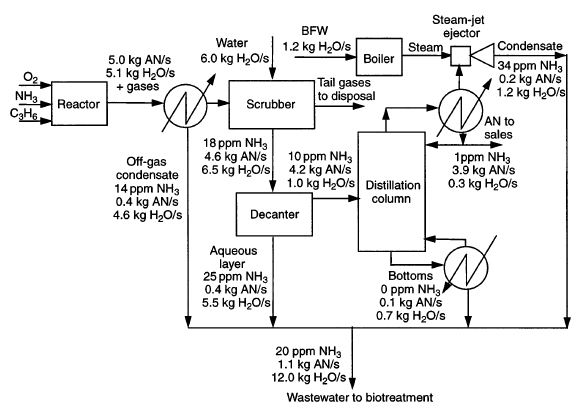
Acrylonitrile production
Just last week, we just finished the mass integration, or the mass exchange networks. We were given a seatwork on this topic. The process flow diagram of this seatwork is shown above, the acrylonitrile production, also discussed in this El-Halwagi’s paper. We were asked how to reduce the need for a fresh water source for the scrubber and the boiler.
The first step in conducting mass integration is the development of a global mass allocation representation of the whole process from a species viewpoint (El-Halwagi et al. 1996, Garrison et al. 1995, 1996). For each targeted species, there are sources, streams that carry the species and sinks.
El-Halwagi stated that in general, sources must be prepared for the sinks through a combination of stream segregation, mixing, recycle, interception and and sink/generator manipulation.
Segregation refers to avoiding the mixing of streams. Recycle refers to the use of a pollutant-rich stream, also known as the source, in a process unit, also known as the sink. This sink, however, has restrictions such as flow rate or concentration of contaminants. This is where interception comes in. It is the utilization of separation unit operations to adjust the composition of the source to make them acceptable for sinks. This entails the use of mass-separating agents (MSAs) or energy separating agents (ESAs). Lastly, the sink or generator manipulation involves the design or operating changes that alter the flow rate or composition of the source entering or leaving the process units. This includes temperature and pressure changes, unit replacement, catalyst alteration, feedstock substitution, reaction-path changes etcetera.
Personally, learning about and solving problems on mass integration is just as fun as in heat exchange networks. But the former seems more complicated than the latter. 🙂
References:
El-Halwagi, M. M. (1998) Pollution prevention through process integration. Clean Products and Processes 1. pp 5-19
 Engineering Perspectives