Environmental Fate: Breaking Bad Style

Environmental fate would give an idea of what happens to chemicals once it is discharged into the environment. There are many ways to express the environmental fate of a particular substance. Most of it are defined by properties of these chemicals which can be calculated using models and software available.

Environmental fate does not only concern itself with what happens to the chemicals. It also involves analysing potential hazards and problems that may arise when they come into contact with organisms such as plants, animals and of course, humans. It can also provide information as to whether certain chemicals may cause adverse effects to the environment especially in the soil and bodies of water.

The importance of evaluating the environmental fate of a chemical should definitely not be taken lightly. What’s sad is that while industries are required to follow regulations on chemical disposal and treatment, there are still those individuals who just don’t seem to care.

Take meth, for example. Meth, or methamphetamine, is a well known synthetic drug not just because of the Breaking Bad series but also because it is considered as one of the most dangerous drugs. While the chemistry behind it could be considered awesome in some sense, its effects—not only upon human intake but also on the environment—are very disheartening.

The following video shows a news report on the environmental impact of the drug:

*Video taken from YouTube: https://www.youtube.com/watch?v=n7P776LKvp0

As seen in the video, for at least six (6) pounds of toxic waste is generated for every 1 pound of the drug. Chemicals used to make meth include acetone, toluene, hydrochloric acid, sodium hydroxide, and anhydrous ammonia. Just the mention of these chemicals would make one cringe when thinking of it being carelessly exposed to the environment. The sad truth is, they are just dumped into the environment with its production and selling being illegal and all. I think only Walter White has the decency to even think of the proper place to make it and dispose of it—even if he is fictional and it is a series.

Nevertheless, there are other chemicals that are being discharged into the environment everyday. Sometimes, we too are guilty of just dumping waste down the drain without even reading the proper disposal on the container labels.

So, what’s the point exactly? The point is, environmental fate is more than just the numbers. I mean, it doesn’t make sense to even calculate numerous values when in the end, all we care about is getting the numbers right and not really what it means.

As engineers, I believe we are not just expected to create less environmentally-degrading products using tools like evaluating environmental fate but we should be pushed into eradicating them, if possible. It may seem highly idealistic and it is but it is what it is. Then again, it may not be. In the end it’s all just a matter of perspective.

And as one of my professors put it:

Save the earth! It’s the only planet that has chocolate!

Sources: methproject.org
“Pollution prevention through process integration”

Process integration is a holistic approach to process design and operation. It emphasizes the unity of the process units and objectives. Therefore, it provides unique framework for integrating environmental issues with other process objectives such as profitability, yield enhancement, debottlenecking and energy reduction.

-Mahmoud M. El-Halwagi

This blog post will basically tackle what El-Halwagi’s paper, the Pollution prevention through process integration.

Traditional pollution control consists of end-of-pipe treatment and disposal. End-of-pipe treatment refers to the reduction of the magnitude of environmentally undesirable compounds in process streams prior to their release to the environment through the application of chemical, biological and physical processes. On the other hand, disposal involves the use of postprocess activities that can handle waste.

The problem with this traditional pollution control is that it does not deal with the root causes of the environmental problems. These problems lie at the core of the process which resulted to new ways for pollution control, namely the source reduction and the recycle/reuse. Source reduction means to eliminate waste before it is created. It involves any in-plant actions to reduce the amount of the quantity or toxicity of what is thrown away. Recycle/reuse are pretty self-explanatory which involves the re-introduction of pollutant-filled streams back into the process.

However, these new ways of pollution control, or in-plant pollution prevention have posed some challenges summarized below.

  • There is no single menu of solutions that fits all. These pollution prevention technologies should be added in the periphery of the process.
  • A change in a unit or a stream propagates throughout the process and may have mahor implications on the operability and profitability of the process.
  • The technical, economic, safety and environmental objectives and constraints must all be reconciled.
  • The solutions lie within the existing process equipment. However, it isn’t obvious how to identify these opportunities.
  • Solution cannot be replicated from one process to another even if they have common technology.

With this, process integration addresses these challenges through three key components: synthesis, analysis and optimization.

Process synthesis deals with combining and integrating process units and streams so as to meet certain objectives.

Process analysis involves the decomposition of the whole into its constituent elements for individual study of performance.

Process optimization involves the selection of the “best” solution from among the set of candidate solutions. The degree of goodness of the solution is quantified using an objective function, e.g., cost, which is to be minimized or maximized.

Process integration has two main branches: the mass integration and energy integration. For our class, the discussion started with energy integration, more specifically, the heat exchanger network.

Energy integration is a systematic methodology that provides a fundamental understanding of energy utilization within the process and employs this understanding in identifying energy targets and optimizing heat-recovery and energy-utility systems.

Acrylonitrile production

                                                          Acrylonitrile production

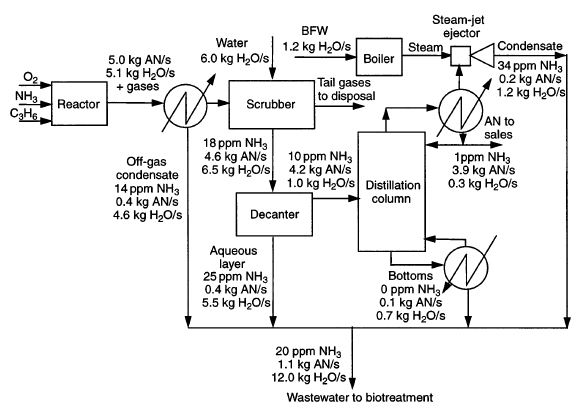
Just last week, we just finished the mass integration, or the mass exchange networks. We were given a seatwork on this topic. The process flow diagram of this seatwork is shown above, the acrylonitrile production, also discussed in this El-Halwagi’s paper. We were asked how to reduce the need for a fresh water source for the scrubber and the boiler.

The first step in conducting mass integration is the development of a global mass allocation representation of the whole process from a species viewpoint (El-Halwagi et al. 1996, Garrison et al. 1995, 1996). For each targeted species, there are sources, streams that carry the species and sinks.

El-Halwagi stated that in general, sources must be prepared for the sinks through a combination of stream segregation, mixing, recycle, interception and and sink/generator manipulation.

Segregation refers to avoiding the mixing of streams. Recycle refers to the use of a pollutant-rich stream, also known as the source, in a process unit, also known as the sink. This sink, however, has restrictions such as flow rate or concentration of contaminants. This is where interception comes in. It is the utilization of separation unit operations to adjust the composition of the source to make them acceptable for sinks. This entails the use of mass-separating agents (MSAs) or energy separating agents (ESAs). Lastly, the sink or generator manipulation involves the design or operating changes that alter the flow rate or composition of the source entering or leaving the process units. This includes temperature and pressure changes, unit replacement, catalyst alteration, feedstock substitution, reaction-path changes etcetera.

Personally, learning about and solving problems on mass integration is just as fun as in heat exchange networks. But the former seems more complicated than the latter. 🙂

References:

El-Halwagi, M. M. (1998) Pollution prevention through process integration. Clean Products and Processes 1. pp 5-19

HEN Application

Last week, we were tasked to do a homework re: heat exchange networks. The problem is stated for your reference:

To produce a high purity product, two distillation columns are operated in series. The overhead stream from the first column is the feed to the second column. The overhead from the second column is the purified product. Both columns are conventional distillation columns fitted with reboilers and total condensers. The bottom products are passed to other processing units, which do not form part of this problem. The feed to the first column passes through a preheater. The condenser from the second column is passed through a product cooler. The duty for each stream is summarized below:

Screen Shot 2015-03-10 at 2.02.17 AM

The minimum approach temperature used was 10degC.

The temperature was divided into 10 segments as shown in the table below. From here, the total heating and cooling loads were calculated and the pinch point was determined to be at 70degC with external heating load of 2300kW and external cooling load of 1600 kW. The solution is shown in the figures below. The respective CP’s were calculated using the equation Q=CP*(deltaT).

Screen Shot 2015-03-10 at 1.32.12 PM

Screen Shot 2015-03-10 at 2.18.53 AM               Screen Shot 2015-03-10 at 2.47.13 AM

Now we need to determine which streams are going to be paired with each other, knowing the pinch point temperature and the external heating and cooling loads.

Screen Shot 2015-03-10 at 1.24.34 PM

Above the pinch (T>70degC), we only have stream 4 and 5, which cannot be paired together since there is not overlap in temperatures and since both are cold streams. Thus, an external heating load is calculated using Q=CP*(deltaT) to get 2300 kW required external heating, which is what we were able to compute earlier. Below the pinch, there are 4 streams – 1, 2, 3, and 6 which correspond to C1, H1, H2, and H3, respectively. Below the pinch the number (and heat capacity) of cold streams must be less than or equal to the number (and heat capacity) of hot streams. Both of these conditions are satisfied so there is no need to split the streams. The cold stream, C1, can be paired with either stream 2 or 3 (H1 or H2). Pairing it with H2 will lower the H2 temperature to ~56.8degC and will need external cooling to lower the temperature further down to 55 degC. Adding the external cooling required for H1 and H3 will result in a total of 1600 kW external cooling load required. Which was what we calculated. A similar calculation can be done by pairing C1 with H1. The same external cooling would also be calculated. Now to select which of these we should use, we must take into consideration the costing and other trade-offs of equipment design. That is another matter which we may possibly discuss in future blog entries. 😉

BIG THINGS MAY COME IN SMALLER PACKAGES

Many attempts have been made by chemical process industries or industries in general geared towards minimization of waste and prevention of pollution without sacrificing much of the quality and profitability of their products.

One key factor that links all four categories listed beforehand would be the process undergone to produce the products itself. The production process starts from the sourcing of the product up to the delivery of products to distribution sectors.

In this blog entry, what will be focused on would be the integration and synthesis of different unit operations and processes which is a helpful tool in deciding the design of the whole industrial process.


Process Integration in simple terms would have to be putting together larger processes to form smaller and more efficient operations. It involves revising parts of the original process and looking for areas which can be utilized and reduce the number of mechanical parts and machines needed in the production.

For example, in heat exchange, both minimum external cooling and heating loads can be identified (using both Algebraic and Graphical methods) so as to maximize the heat exchange potential of all hot and cold streams and to minimize the number of utilities to be used in heating and cooling the product. This may not only lower costs in buying the heat exchangers and utilities, it may also improve the quality of the product depending on the heat exchange calculated.

Another advantage of Process Integration is that it helps lessen the amount of waste generated by the process. Along with identifying steps which could be done simultaneously or using one unit only comes the discovery of steps which generate the highest amount of waste whether it be harmful or not. Using process integration, these steps can be further developed and change so as to lower the amount of waste generated for the whole process. This does not only increase the efficiency of the operation but also lowers costs for the treatment of these wastes.

With advantages come the disadvantages of using Process Integration. More often than not, there would be more than one way to enhance the process in an industry. This is because there are many areas to choose from in which process integration may be applied and with every option comes the cost for either buying the equipment, maintaining the equipment and more. This is also the reason why all designs would often come with a financial proposal listing both costs and profits for either long term or short term perspectives.

Another risk in using process integration would be the assurance of still high quality products. The standards for the products would still have to be met which includes the pricing of the products which is also affected by the kind of processes undergone by the raw materials. And while waste minimization may be a result of process integration, it may also be a negative effect.

At the end of the day, it all comes down to compromise. While it is true that process integration is a helpful tool in creating a more organized and efficient plant design, its effects to the quality, cost and waste generation should also be taken into careful consideration. This may be the reason why some companies still rely on long and arduous processes which may not be as efficient as they want it to be but nevertheless delivers the quality, cost and waste generation they desire.