“It is imperative that an international corporation adopt progressive environmental management practices aimed at pollution prevention in every facility it owns or operates throughout the world. The benefits include reduced environmental risks and costs, higher manufacturing efficiency and lower manufacturing costs, a positive public image and progress toward sustainable development.”
—Rao, J.J.
The excerpt above was taken from a journal article entitled Preventing pollution around the world by J.J. Rao back in 2001. It discusses general strategies CPIs can adapt in order to minimize their wastes which brings about progress not only for the company but for the generations to come. The recommendations were simple yet effective and would certainly bring about a good kind of change. One key point of the article would be that pollution prevention is not an effort of only one sector or department in the company, but entails the cooperation, discipline and compliance of all. In a bigger scale, pollution prevention is never an effort of just one country.

Image taken from: http://solutions.3mbelgie.be/3MContentRetrievalAPI/BlobServlet?lmd=1271336995000&locale=nl_BE&assetType=MMM_Image&assetId=1258565727861&blobAttribute=ImageFile
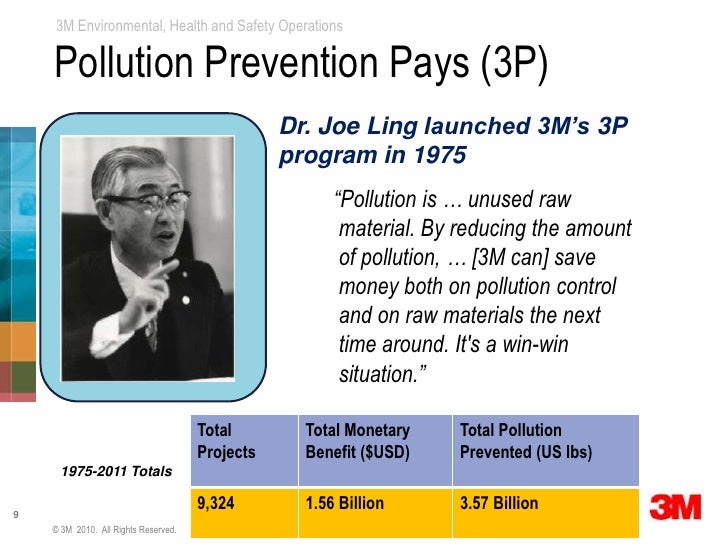
In 1975, 3M pioneered what could be considered as one of the most successful and influential pollution prevention program—the 3P or Pollution Prevention Pays. The title itself could be considered as a market strategy already. What company doesn’t want to reduce waste and gain profit at the same time? It’s like a kid on a Christmas morning.
As said by Rao (2001), reduced waste correlates to high manufacturing efficiency—which makes a lot of sense. High manufacturing efficiency entails excellent and efficient processes which optimizes the use of essential raw materials therefore minimizing the waste at the end. So, 3P does pay in terms of saving money intended for treating billions of pounds of industrial waste.
As Dr. Joe Ling elegantly puts it:

A person back in 1975 would have thought his words were bogus but facts never lie. In 2005, 3M reported to have prevented 2.9 billion pounds of pollutants and saved more than 1.2 billion US dollars worldwide; and as shown in the photo above, in a matter of 36 years, their 9,324 projects have prevented 3.57 billion pounds of pollutants and saved over 1.56 billion US dollars.
The concept was easy to understand one would think how else could people have missed it and ignored it for such a long time:
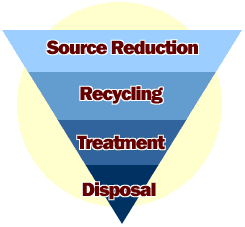
Image from: https://www.iisd.org/business/images/diagram_bt_pp.gif
The inverted triangle shows that it all starts in reducing the waste at its source. If pollutants can be eliminated through tweaking certain operations, the better. It also implies that at the final step, disposal, waste should have been greatly reduced if not completely eliminated.
As mentioned earlier, pollution prevention isn’t just an effort of one department, say the manufacturing department. Another good concept involved in the 3Ps is that it involves the voluntary participation of all employees. In 2002, the program was also expanded to include participation of R&D, logistics, transportation and packaging employees. Now, the 3P program (or pollution prevention programs in general) has been implemented by various companies around the world.
Now, it doesn’t take such a genius to implement the basic principles of 3P or pollution prevention in general. More than knowledge (which could be easily attained), discipline and compliance (which are harder to master, apparently) would play bigger roles in its success. 3P wasn’t made for just big-time industries, even households can certainly do it. So what’s an excuse for not doing it? Basically, none.
References:
Rao, JJ., (2001). Pollution prevention around the world. Chemical Engineering Progress: Nov 2001; 97, 11 (p. 38-31).
Sustainability In-depth: The Pollution Prevention Pays (3P) Program. Taken 10 February 2015 from http://solutions9.3m.com/3MContentRetrievalAPI/BlobServlet?locale=en_US&lmd=1240969645000&assetId=1180581674144&assetType=MMM_Image&blobAttribute=ImageFile.
 Engineering Perspectives